
Managing High-Density Repeat Sets for Maximum Material Yield
Strategic array layouts, kerf allowances, and tessellation methods to duplicate identical components across vinyl sheets and cutting mats with near-zero waste.
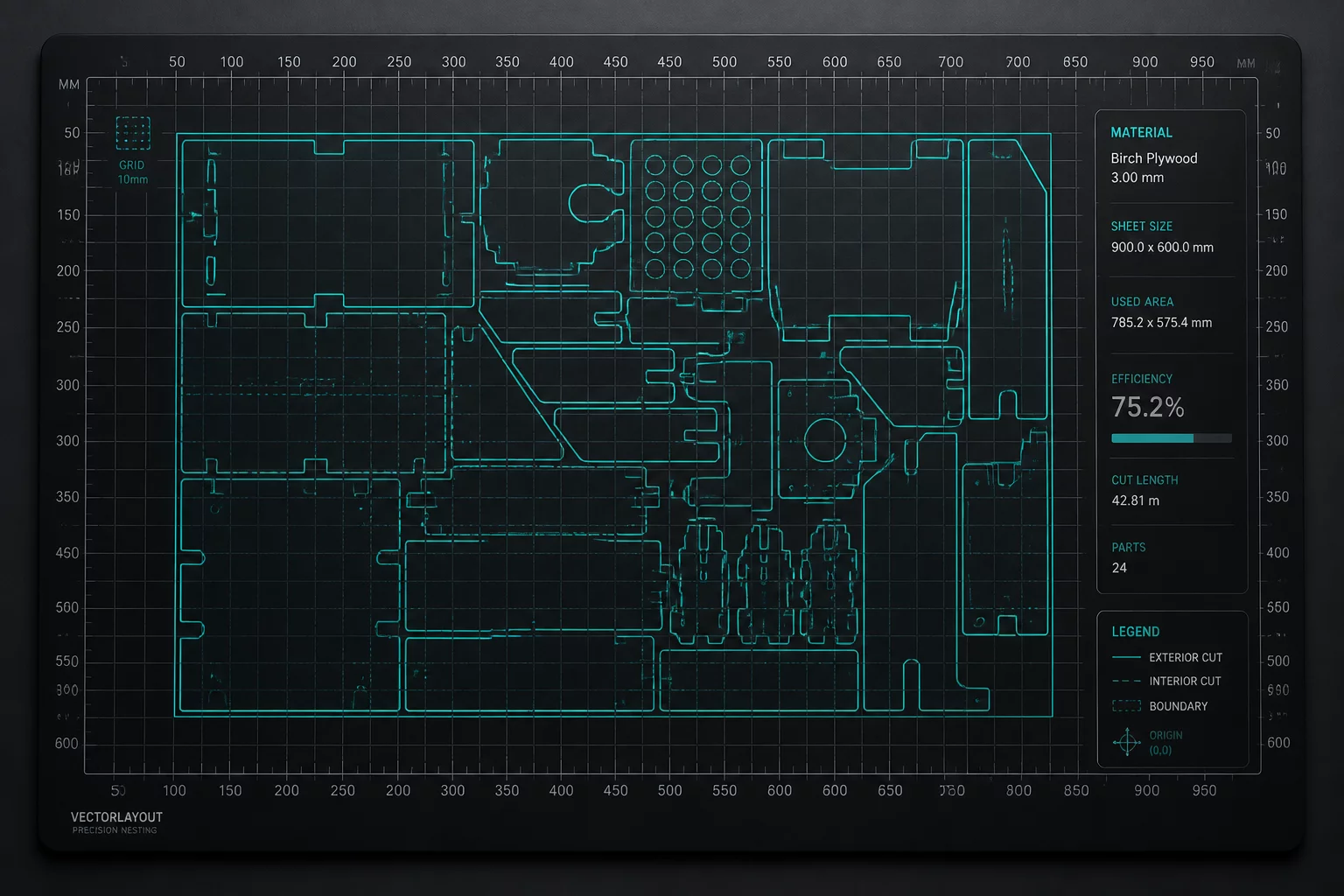
Architecting High-Yield Repeat Sets on Flat Media
Compare placement, material direction, spacing, and post-cut handling using your actual pieces and sheet boundary. Learn structural nesting rules, blade path sharing, and stepped arrays designed to maximize yield.
Geometric Tessellation Over Grid Snapping
Eliminating dead space between identical die-cut contours
Placing identical designs in uniform rows and columns is the standard default in most CAM software, but it creates continuous corridors of unused material. By analyzing bounding box silhouettes and alternating angles, tessellated arrays interlock convex curves into concave voids.
Three Fundamental Array Constraints
- Kerf & Blade Clearance: Always preserve minimum 1.5mm to 2.5mm separation to avoid blade deflection and tearing on delicate sticker stock.
- Grit Roller Track Reservation: Keep clear margins along pinch-roller paths on roll-fed cutters to avoid tracking skew.
- Registration Mark Inset: Optical sensor safe zones override perimeter tessellation bounds by at least 15mm.
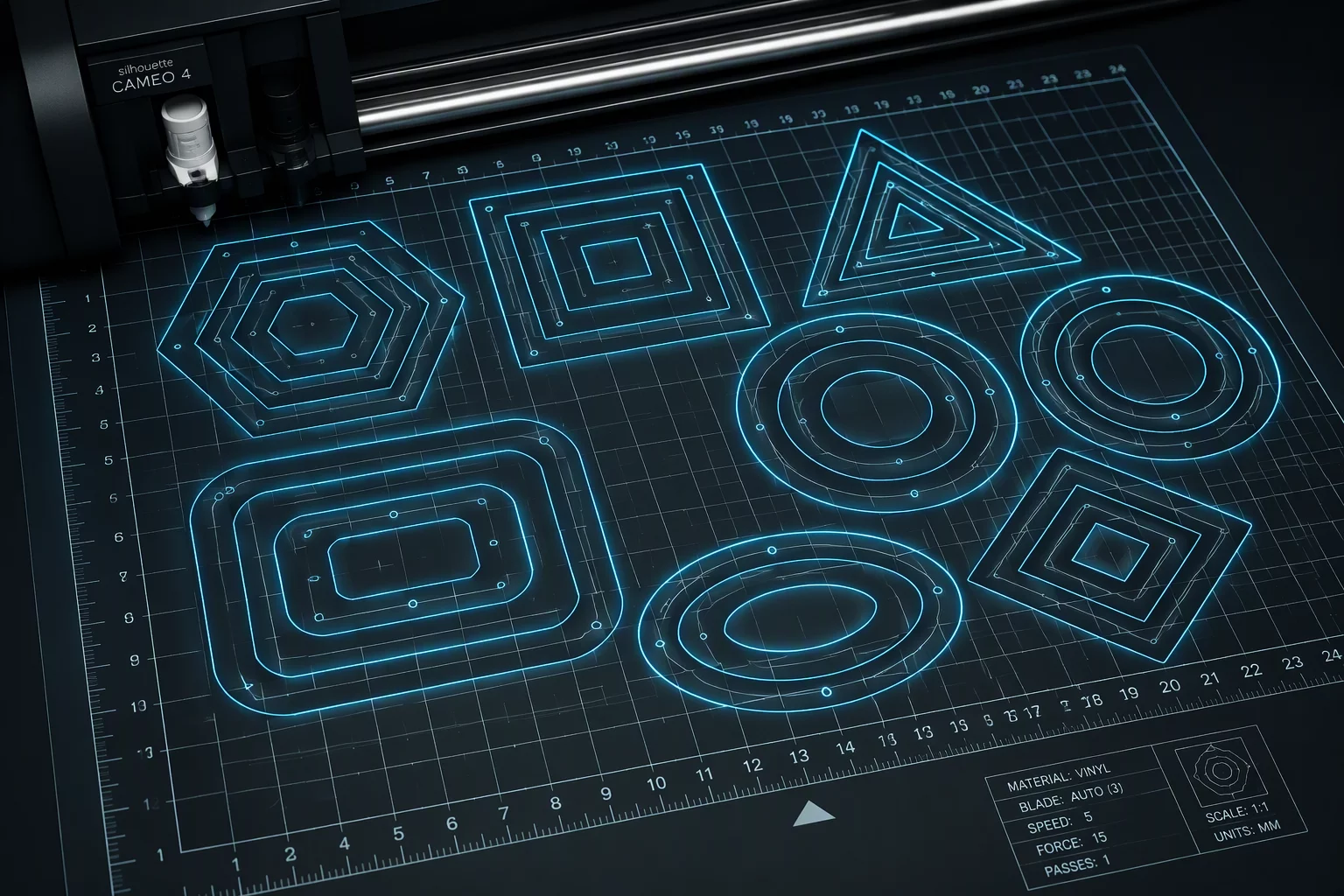
Nested Honeycomb vs. Standard Matrix
Visual comparison of 38-unit staggered yield versus 30-unit standard orthogonal placement.
Rectangular Repeat Grid Preview
Planning example for rectangular pieces only. Counts use the entered sheet and piece dimensions, margin, and spacing. Area coverage is geometric coverage, not a measured material-saving claim; verify the layout and orientation in your cutting software.
Calculate total output, net surface utilization, and expected scrap percentage for single-item repeat production runs.
Repeat Array Strategies Compared
Choose the ideal layout archetype based on your design silhouette geometry.
Orthogonal Uniform Grid (Standard Cartesian)
Best suited for perfect rectangular decals, square tags, and circular badges where non-uniform rotation provides zero area reduction. Cuts proceed along straight continuous X and Y toolpaths.
Higher scrap volume, but easiest weed box separation for batch production.
Expand Your Nesting Mastery
Sheet Layout in Silhouette Studio
Step-by-step instructions for setting up duplicate matrices, registration mark safety, and cut lines.
Margin Decisions & Roller Clearance
Determining safe border allowances to prevent mat drift and cutter head misalignments.
High-Volume Production Sets
Batch cutting protocols, multi-sheet tiling, and repeatable workflow automation.
Handling Multiple Unique Sizes Together?
Discover how bin-packing algorithms arrange mixed-dimension die cuts onto single sheets without wasting offcut corners.