
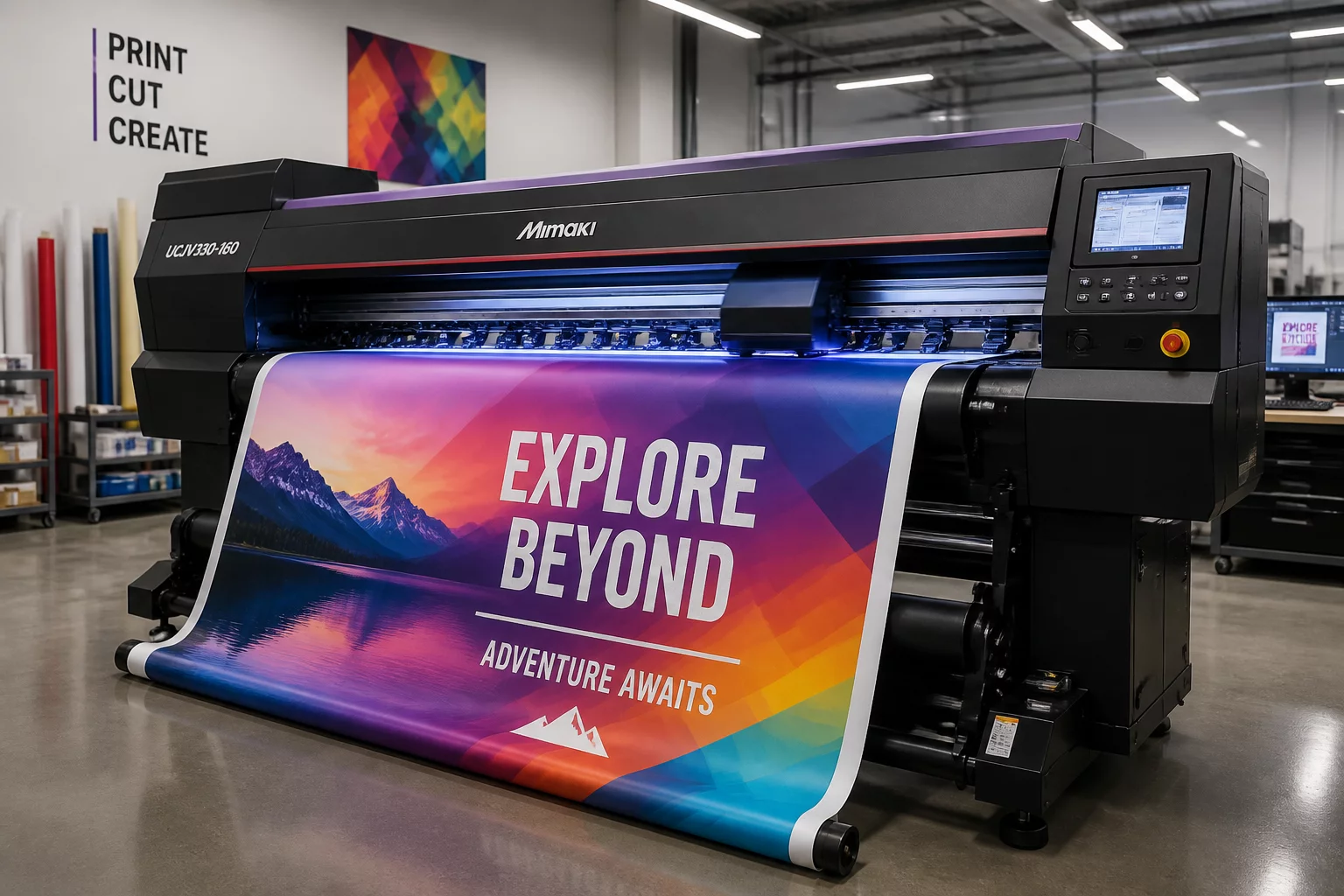
MUTOH America's recent industry awards highlight a crucial evolution in wide-format digital production: the convergence of high-speed color rendering and mechanical contour cutting precision. For workshop operators managing nested sheet and roll yields, these technical milestones redefine how tightly mixed cut files can be arranged without risking perimeter registration drift.
Mechanical Feed Stability and Yield Protection
Long-bed contour cutting introduces cumulative tracking errors whenever flexible media experiences thermal expansion or uneven roller pinch tension. MUTOH's latest multi-zone pressure rollers distribute downward clamping force proportionally across wide-format rolls, virtually preventing the lateral skew that ruins nested perimeter decals. In production environments where nested files run across twenty continuous yards, a millimeter of drift at the boundary means wasted vinyl and lost profit.
The integrated optical registration system reads micro-targets between nested component clusters rather than relying solely on sheet corner marks. Because the sensor recalculates vector coordinates in segmented blocks, slight material stretch caused by heavy ink saturation does not throw off subsequent cut paths. This localized compensation allows designers to push components within 2.5 millimeters of each other, noticeably increasing overall sheet yield.
Workflow Integration: From Vector Nesting to Finished Cuts
Commercial shops frequently juggle diverse job tickets consisting of geometric decals, irregular lettering, and rigid prototype overlays. Running these jobs through MUTOH's RIP and automated contour pipeline demonstrates tangible workflow gains across three critical metrics:
- Dynamic mark generation automatically places intermediate registration targets within dead space inside nested layouts, ensuring zero added margin waste.
- Multi-tier speed modulation slows the toolhead on sharp internal radials while accelerating across straight perimeter runs, preventing material tearing.
- Bi-directional communication feeds real-time blade wear metrics back to the operator console, signaling replacements before edge fraying begins.
Segmented Alignment Over Global Marks: Localized optical registration prevents progressive drift on flexible materials, allowing tighter nested spacing without safety padding.
Balanced Roll Pressure: Even pinch pressure across 64-inch webs ensures tight nesting boundaries remain true from the first cut to the fiftieth meter.
Morgan has spent over a decade calibrating industrial plotter cutters, evaluating wide-format digital print systems, and optimizing sheet yield workflows for commercial craft and signage operations.

Community Review & Notes
Add Your Experience