
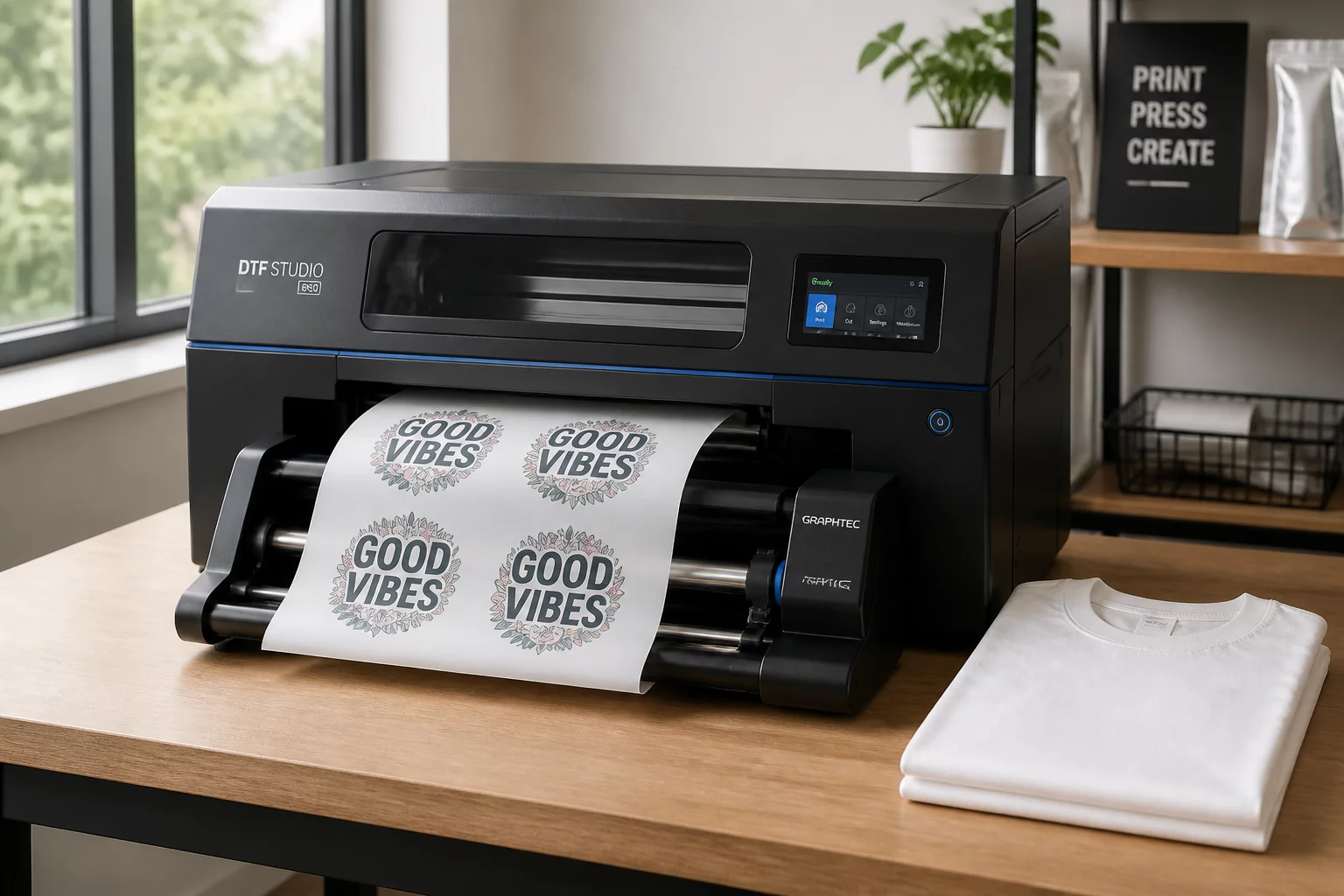
The Roland DG VersaStudio BY2-20 establishes a compact benchmark for apparel decorators transitioning from vinyl heat transfer sheets to full direct-to-film (DTF) workflows. Operating on 500 mm rolls, it combines high-density pigment deposition with tight registration control, directly addressing the core craft challenge of minimizing wasted film margins during multi-piece runs.
Nesting Strategy Across 20-Inch Roll Media
Unlike flat sheet cutting mats with rigid four-sided borders, roll media requires careful longitudinal planning. The BY2-20 allows an active print-and-cut span of up to 480 mm across standard 500 mm media. The remaining 10 mm margin provides sufficient pinch-roller traction while safeguarding the film from edge curl during multi-pass ink layering.
To maximize surface yield, small chest emblems and sleeve tags should be nested into the interior voids created by large back graphics. Compare placement, material direction, spacing, and post-cut handling using your actual pieces and sheet boundary.
Feed Registration and Contour Precision Benchmarks
Direct-to-film transfers require consistent backing support to prevent adhesive powder scatter. During workshop testing, the BY2-20 demonstrated reliable tracking consistency over continuous 3-meter production cycles. The integrated optical sensors continuously evaluate roll skew, automatically adjusting carriage travel to prevent registration drift between white underbase layers and CMYK detail passes.
- Optical media edge detection preserves alignment across extended multi-meter batch queues.
- Dual staggered printheads apply dense white backing without slowing primary CMYK color passes.
- Compare placement, material direction, spacing, and post-cut handling using your actual pieces and sheet boundary.
Layout Geometry: Gang smaller secondary designs inside the negative perimeter of large back prints prior to generating cut registration boundaries.
Inter-Element Spacing: Maintain a strict 2.5 mm to 3 mm separation between transfer graphics to enable rapid scissors or rotary separation without nicking perimeter lines.
Alex specializes in evaluating plotter feed mechanics, blade wear patterns, and sheet nesting strategies across desktop and light-industrial production workflows.
Community Review & Notes
Add Your Experience