
Apparel Pattern Layout Challenge
Optimize textile cutting yield on wide-width roll stock while locking axial grainlines and preserving critical blade clearances across multi-sized garment panels.
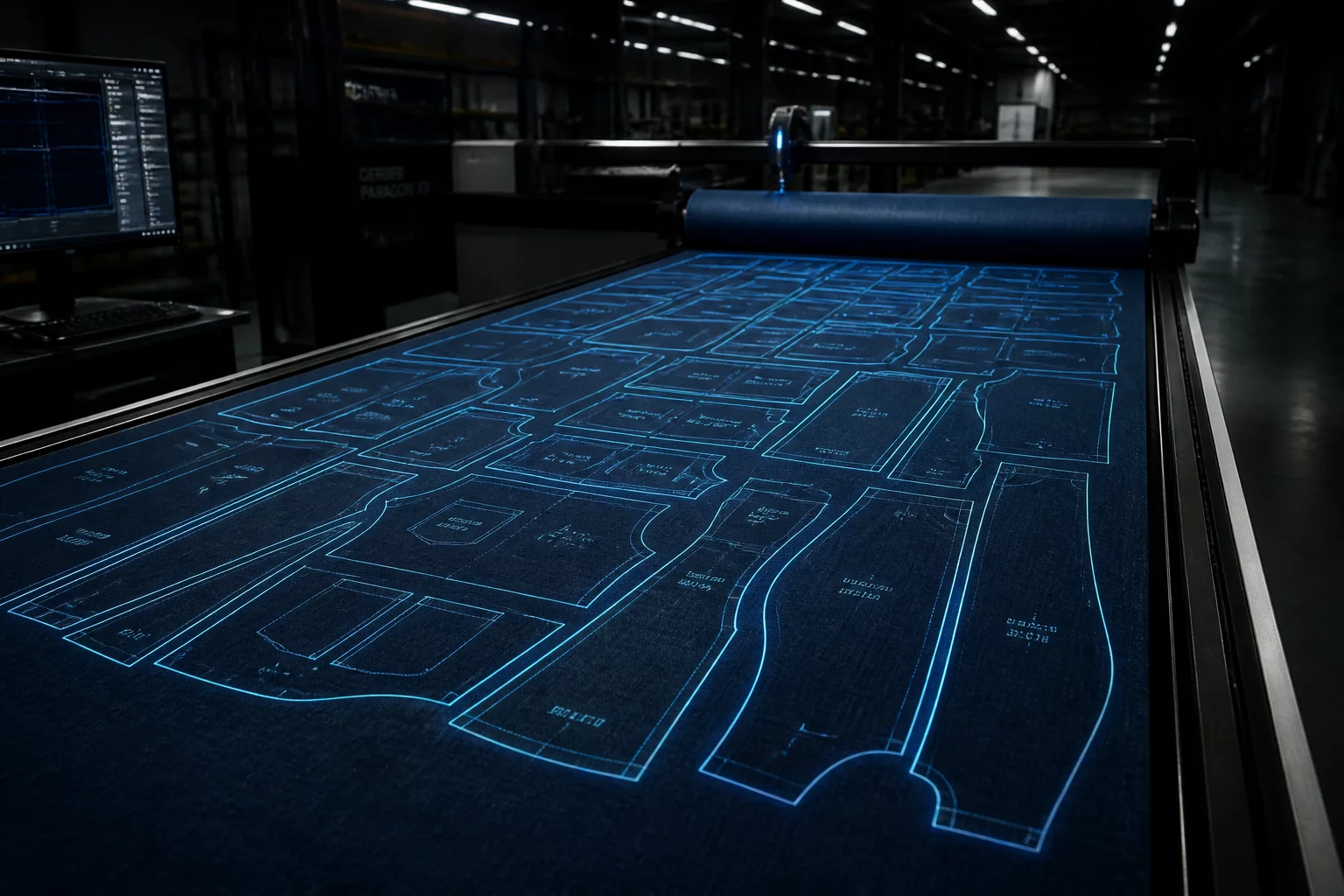
01 Fabric Grainline Alignment & Dimensional Geometry
Textile pattern layout introduces a physical constraint absent in rigid sheet cutting: mechanical fabric stretch along warp and weft directions. Compare placement, material direction, spacing, and post-cut handling using your actual pieces and sheet boundary. Operators must lock nesting rotation limits to parallel or 180-degree grainline reversals.
Automated shape-nesting engines often treat vector paths as generic geometric contours. Without explicit orientation constraints, algorithms will slot complex curves into irregular voids at arbitrary angles. Setting axial grainline boundaries ensures your software groups complementary curves—such as slipping sleeve caps along concave front panel edges—without violating vital warp alignment requirements.
Pair concave curves directly against convex panels of smaller sizes. Rotating paired sleeves 180 degrees along the locked grainline axis nests shoulder crowns snugly into side seam tapers, recapturing substantial scrap yardage.
Advance Your Digital Nesting Precision
Master sheet margin calculations, grouped production templates, and automated nesting setups in our structured workflow guides.
02 Cutter Knife Clearance and Vacuum Buffer Stability
High-speed reciprocating knife cutters and drag blades exert physical drag when slicing through woven textiles and multi-ply spreads. Spacing patterns too close together reduces localized vacuum hold-down, pulling fabric plies into the blade path and skewing adjacent components. A safety margin buffer of 5.5 to 6.5 mm provides the clearance required to prevent layer migration.
For laser-based apparel cutting systems, the challenge shifts from mechanical deflection to heat dissipation and kerf vapor management. Grouping parts with consistent cut spacing prevents heat concentration from fusing delicate synthetic edges across densely nested micro-panels.
Cutting expansive perimeter contours too early breaks airtight vacuum hold. Sequence toolpaths from inner pocket notches and small collar bands outward to maintain steady bed pressure.
Compare placement, material direction, spacing, and post-cut handling using your actual pieces and sheet boundary.
03 Production Staging & Bundle Organization
Organizing pattern pieces in size-specific linear clusters along the roll length simplifies downstream bundling for sewing operators. Retaining paired left and right components in nearby clusters speeds post-cut sorting, turning high nesting density into real-world shop floor throughput.
Never sacrifice warp grain direction for nominal sheet-nesting percentages. Combining 180-degree axial locking with complementary boundary nesting delivers both optimal fabric utilization and balanced garment structure.
Workshop Feedback & Results
Leave Your Workshop Result