
Optimizing 50 Stickers on a Single Sheet
Mastering tight nesting grids, registration clearances, and blade travel paths when fitting a high volume of small circular and badge graphics onto a single media surface.
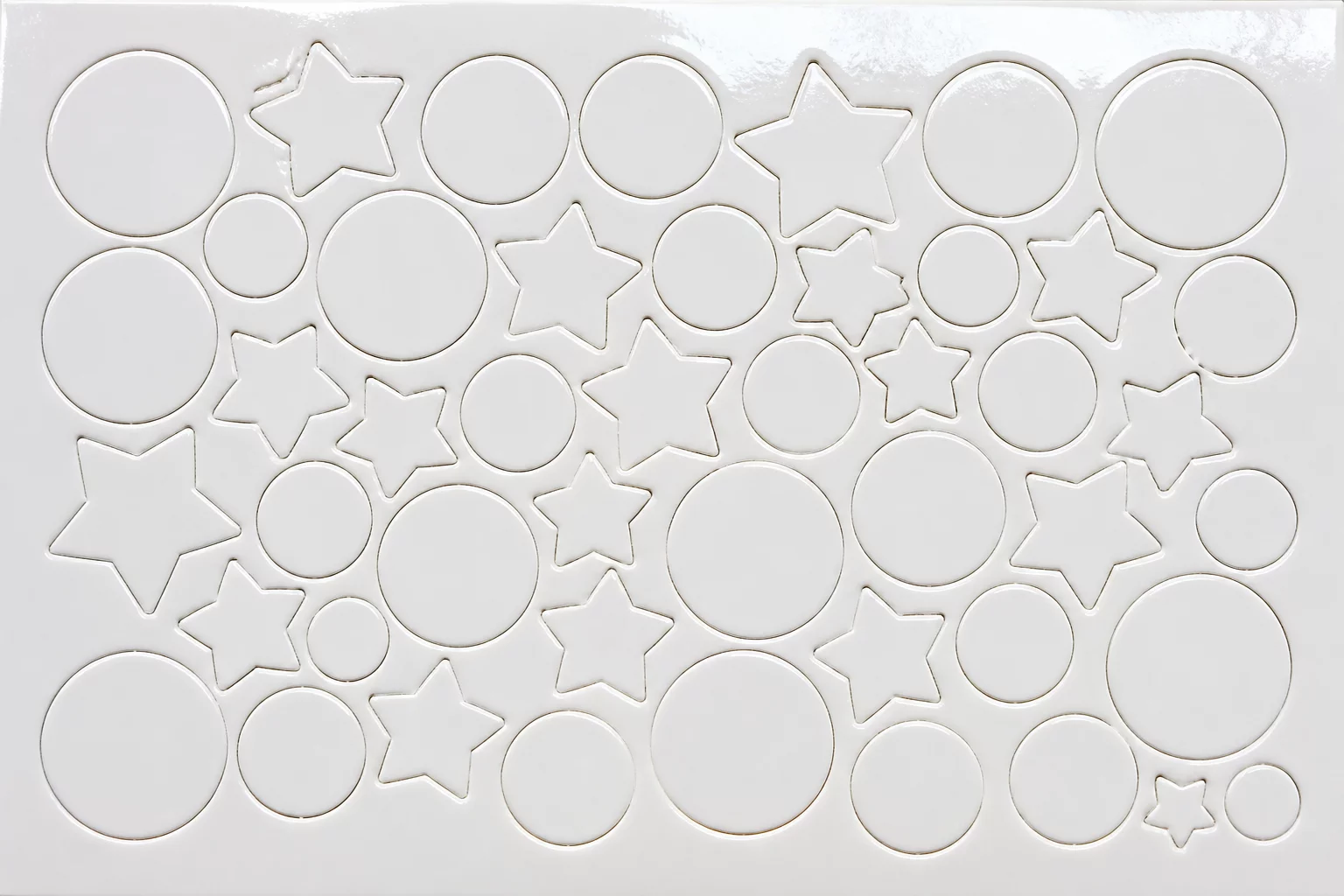
01 The Density Equation: Grid vs. Honeycomb Staggering
Fitting fifty small die-cut stickers onto a standard 8.5x11 inch or A4 adhesive vinyl sheet requires strategic spacing rather than simple rectangular alignment. Standard rectangular bounding boxes leave significant dead zones between adjacent circles and rounded shields. By applying an alternating honeycomb offset (hexagonal close packing), the diagonal gap shrinks from 6 mm to less than 2.8 mm while maintaining complete perimeter integrity.
Software nesting engines often struggle with uniform circles because bounding boxes remain orthogonal squares unless true shape contouring is enabled. Arranging rows in staggered odd/even columns allows the curvature of row two to nestle between the shoulders of row one. This geometric shift alone recovers enough horizontal clearance to fit two extra columns across standard sheet widths.
Always establish your cut outline offset and weed-border clearances on a single sticker component before duplicating it across the sheet. Duplicating un-grouped vectors creates messy multi-layer overlapping cut lines that double blade wear.
Mastering Print-Then-Cut Registration Margins
Learn how optical sensor marks alter the usable layout area and how to prevent sensor read failures when placing graphics near corner marks.
02 Blade Travel Optimization and Sheet Stability
When a plotter cuts fifty dense shapes in rapid succession, material shifting becomes a tangible risk on lighter adhesive backing. Cutting stickers in consecutive localized clusters prevents the media from lifting off the cutting mat. If the machine cuts item 1 at the top left and jumps immediately to item 50 at the bottom right, vacuum hold or mat adhesion weakens prematurely across the center.
Organizing cut order by horizontal bands or spiral inward sequences maintains maximum sheet rigidity until the final outer perimeters are severed. For kiss-cut sticker sheets, maintaining at least 1.8 mm between cut paths prevents the backing liner from delaminating during high-speed weed runs.
Keep outer sticker edges at least 12 mm away from the left and right grit roller paths. Driving blades through roller track zones causes inaccurate track feed and blade snagging.
A staggered layout delivers 50 complete 1.75-inch units per sheet compared to only 38 units when aligned in standard orthogonal square matrices.
03 Weeding Flow and Post-Processing Efficiency
High nesting yield should never compromise stripping speed. Introducing micro weeding boundary lines dividing the 50-sticker grid into quadrants enables quick excess vinyl removal without tearing delicate sticker corners. With structured quadrant dividing lines, operators strip waste in four effortless pulls instead of fighting one massive sheet-wide web.
Prioritize staggered hexagonal offsets for rounded geometry, respect grit roller safety zones, and group vectors before duplicating to guarantee pristine cuts and maximum material savings.
Workshop Feedback & Results
No comments yet. Be the first to leave your workshop notes and results!
Leave Your Workshop Result